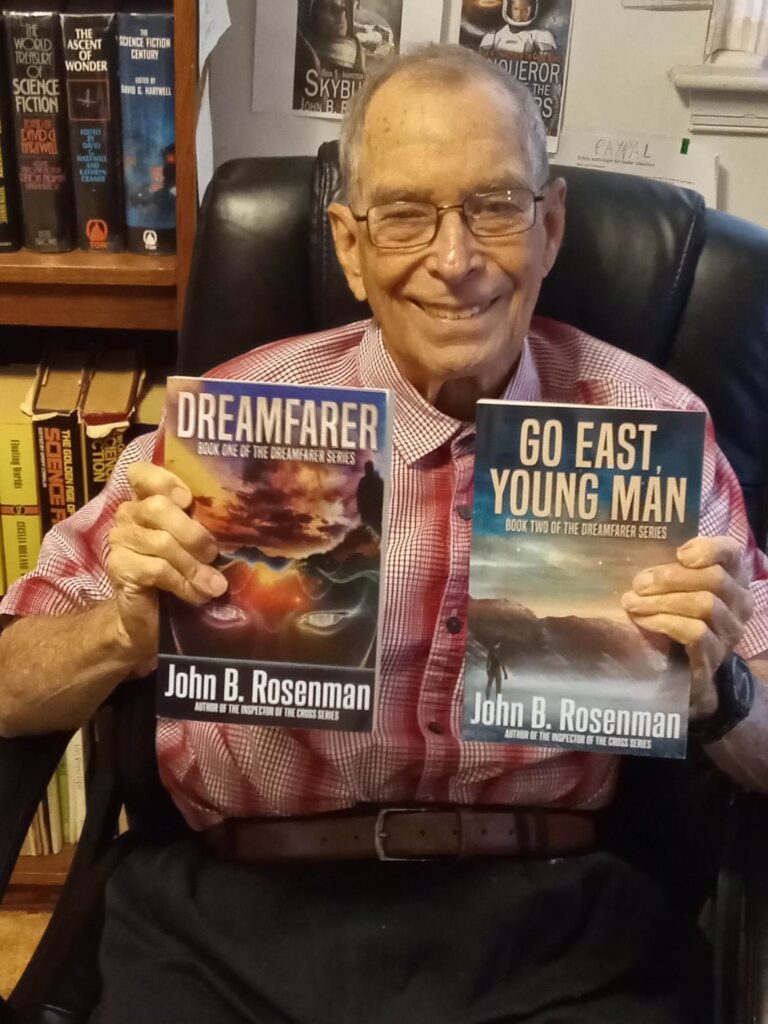
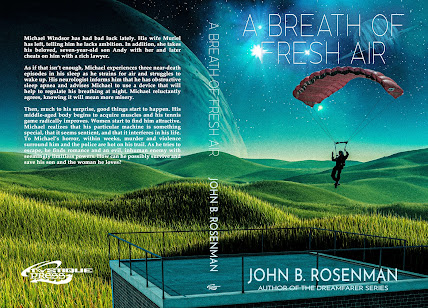
AVAILABLE AT . . . http://www.mundania.com/author.php?author=John+B.+Rosenman
Beyond Those Distant Stars, published by Mundania Press, has received two more great reviews lately. Here’s the latest, which I just received from Target Audience Magazine. Beyond Those Distant Stars is this year’s winner of Allbooks Review Editors Choice Award. If you like action-adventure space opera with mind-stretching concepts and a wild romance, then this book may be for you.

My SF action-adventure-romance novel, Beyond Those Distant Stars,
won AllBooks Review Editor's Choice Award. It has also a highly appreciative review by Tribute Books at . . .
received a highly favorable review at . . .
http://bit.ly/dbP8A9
I've been informed that a review of the novel has also been
posted at Amazon, B&N.com, Goodreads, LibraryThing, Examiner.com,
Midwest Book Review and New York Journal of Books.
Among other things, the reviewer, Nicole Langan, wrote:
Rosenman fills each page with a source of tension that unfurls
the plot at a rapid pace. The reader feels at one with Stella
as she single-handedly turns the tide of an entire war. Her
feeling of otherness, brought about by her new body, allows her
to establish a unique connection with the All-Mother. Her
passion for Jason is put to the test and she must choose
between her personal longings and the good of humanity.
Overall, Stella McMasters makes geek chic for a feminine
audience.
[End of Shameless Plug].
The Boomerang of Revelation
My best experience with a work in progress isn’t a particular event, but a kind of experience. It happens at some point with every book, but I first became aware of it when writing my second novel, The Willies. [http://www.hamishmacdonald.com/novels/novels/TheWillies.html]
I’m a huge fan of outlining. Before I start a novel, I plot out the whole arc of the story. It’s like taking a map on vacation: You can still wander all you like, but you won’t get lost or fall off a cliff. Some people start at Page One and that works for them — most notably Stephen King, as he claimed in his book, On Writing — but I find I can let go more when I can trust that I know where I’m going. Having a map of Paris is completely different to walking through its streets, so I don’t think it spoils the fun at all; in fact, it makes sure you don’t miss the best sights.
Isn’t outlining everything in advance like opening your Christmas presents early? No, because unlike a Christmas present, the stakes with a story are different: There might be a dead chicken in the box, and it’s best to know that before you’ve committed a year or two to the project.
That said, there’s always a point with every book when I discover some piece of the map is blank: I thought I’d filled that in, but something here doesn’t connect. With The Willies, that happened at the end, and the whole story fell into a pothole in the road. How does it end?
The Willies is a science fiction/thriller/comedy story about two friends who discover they’re clones. The lead character, Hugh, has a perfect memory: everything he’s ever seen and heard is stored up in his head. He and his childhood best friend, Simon, were products of an experiment and were never meant to be born, and now someone wants them dead. So by the end, they’ve been on the run for about 250 pages, wrestling as they go with the difficult friendship they’ve had. But how would it resolve?
(Spoiler warning: I’m going to talk about the ending here, in case you might consider reading the book.)
I figured something would turn up for the ending, so I did as Rilke says and “lived the question”: I met up with my folks and we went on a trip to Europe. Spending time with my parents as friends is important to me, but I had an ulterior motive for one particular leg of this trip: I’d been thinking for a while of moving to Scotland, but I wanted to see it again for myself, see what it was really like as opposed to the idea I had of it, so I could put it out of my head and settle down in Toronto.
Waking up one morning at a relative’s farm near Aberdeen, I was hit by a double thunderbolt: I knew I had to move to Scotland (I mean, come on, just look at my name!), and I knew how The Willies ended: Hugh had to forget Simon. Something had to change in Hugh to make him lose his memories — and, with them, his fixation on his old friend — so he could start again.
It unfolded so simply and made so much sense, resolving both the external conflict of the story and Hugh’s internal one — that it was like that had been there in the story’s DNA all along but I’d missed it.
This has happened at some point with all four of my novels. I don’t know where these things come from, and I feel like I’m not clever enough to come up with the patterns that weave so deeply into these stories then tie them all together on a ‘meta’ level. Wherever they’re from, at this point I just count on the mechanics of it, so when I find myself standing in a Parisian street that’s just pencil-marks and blank space, I throw the story out to the universe and wait for it to come back completed.